NEWS
詳細宮城県のインバウンドを、地方での滞在と地域の循環へ
From Inbound Tourism in Miyagi to Longer Stays and Regional Circulation
― 新規訪日客、リピーター、国内旅行者、地域社会をつなぐGAIA Resort ―
Connecting First-Time Visitors, Repeat Guests, Domestic Travelers, and Local Communities through GAIA Resort
訪日旅行市場は、訪日客数4,000万人の時代を迎え、新たな段階に入りつつあります。
旅行業界メディア「トラベルボイス」は、EYストラテジー・アンド・コンサルティングが公表した最新レポート「持続可能なインバウンド市場の構築に向けて~地方分散、リピート化の視点から何をすべきかを考える~」を紹介しています。
同レポートでは、訪日客数や旅行消費額といった大きな数字だけを見るのではなく、国・地域、訪日回数、年齢、滞在日数、消費傾向などを細かく分析し、それぞれの市場に合った戦略を設計する必要性が示されています。
また、地方においては、地域固有の資源を見極め、宿泊を核として周辺地域や多様な事業者と連携しながら、旅行者の滞在時間と地域での消費・交流を生み出していくことが重要であると指摘されています。
私たちガイアグループにとっても、これは重要な視点です。
GAIA Resortは、宮城県をはじめとする地方を中心に、地域に点在する宿泊施設、温泉、食、農業、自然、文化、人との交流をつなぐ分散型の滞在を展開してきました。
私たちは、宮城県におけるインバウンドの新規需要とリピート需要の双方を受け止めるとともに、日本国内から訪れる旅行者、地域に暮らす方々、移住者や二地域居住者、地域の事業者との交流を生み出すことを大切にしています。
Japan’s inbound tourism market has entered a new phase, with the number of international visitors reaching 40 million.
Travel Voice, a Japanese travel-industry media outlet, recently introduced a report published by EY Strategy and Consulting: “Toward Building a Sustainable Inbound Tourism Market: What Should Be Done from the Perspectives of Regional Dispersion and Repeat Visits?”
The report emphasizes that tourism strategy should not rely only on large-scale figures such as total visitor numbers and spending. It calls for more detailed analysis by country and region of origin, number of visits to Japan, age, length of stay, and spending behavior, in order to develop strategies suited to each market.
For regional destinations, the report also highlights the importance of identifying local assets and creating longer stays, local spending, and meaningful exchange by building partnerships around accommodation.
This is an important perspective for the GAIA Group as well.
GAIA Resort has developed a distributed-stay model centered in regional areas including Miyagi Prefecture. We connect accommodations scattered across the region with hot springs, food, agriculture, nature, culture, and encounters with local people.
We seek not only to welcome both first-time and repeat international visitors to Miyagi, but also to create opportunities for interaction among domestic travelers, local residents, migrants, dual-location residents, and regional businesses.
宮城県の外国人宿泊需要と、GAIA Resortの役割
Foreign Guest Demand in Miyagi and the Role of GAIA Resort
宮城県のインバウンド市場は、着実に拡大しています。
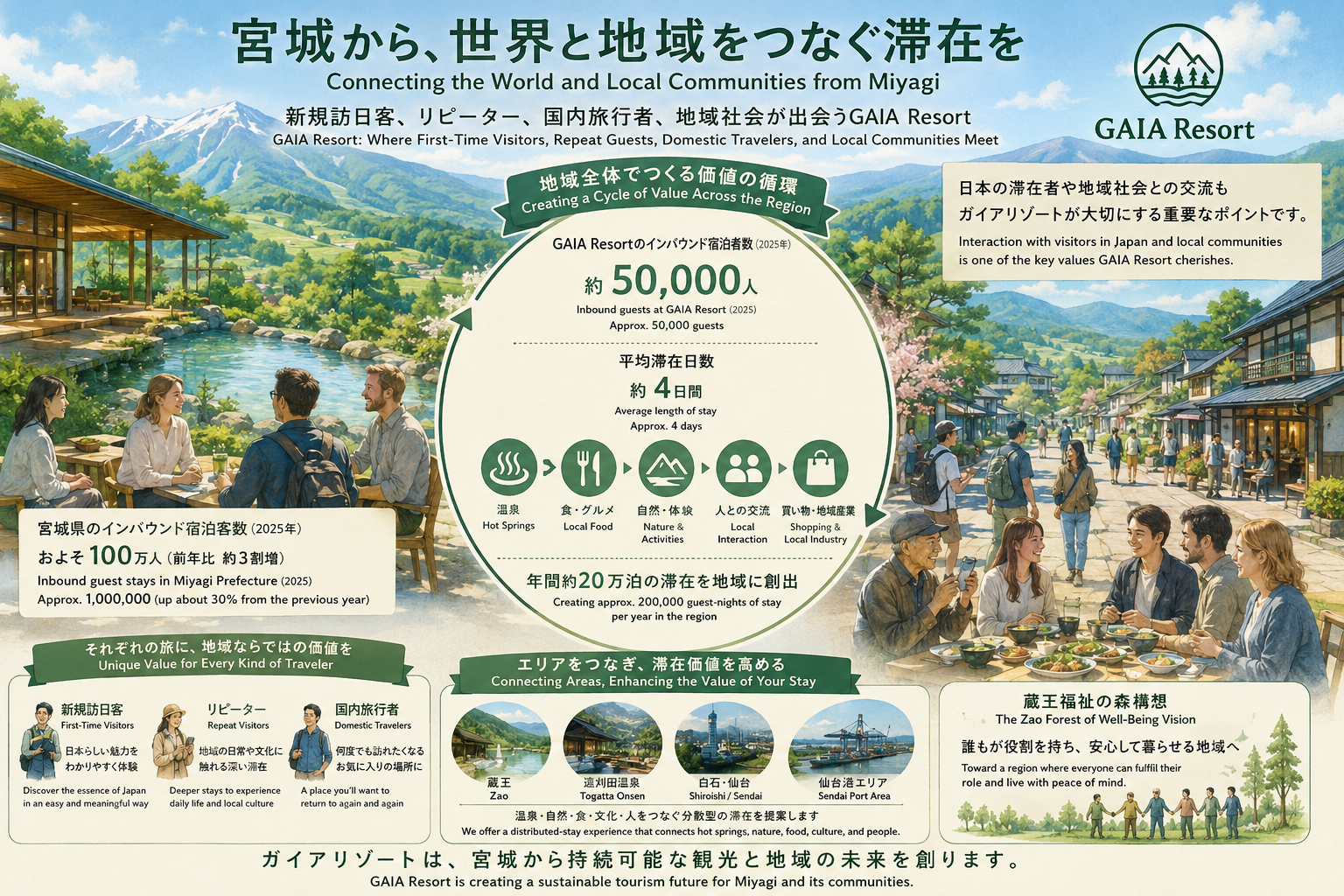
2025年の宮城県における外国人宿泊客数は、過去最高となるおよそ100万人に達し、前年から約3割増と、全国でも上位の伸び率を示しました。
そのような宮城県全体の成長の中で、GAIA Resortに宿泊されたインバウンドのお客様は、年間約50,000人に達しています。
さらに、GAIA Resortにおけるインバウンドのお客様の平均滞在は、約4日間です。
これは、宮城県を通過するだけではなく、蔵王をはじめとする地域に滞在しながら、温泉、自然、食、農業、文化、地域の人々との交流を楽しむ旅が選ばれていることを示しています。
年間約50,000人のインバウンドのお客様が平均約4日間滞在するとすれば、GAIA Resortは年間約20万泊規模の滞在を地域に生み出していることになります。
その滞在は、宿泊施設の中だけで完結するものではありません。
地域で食事をし、温泉を利用し、商店を訪れ、森を歩き、農の風景に触れ、地域の人々と出会う時間へと広がっていきます。
私たちは、宮城県のインバウンド市場を支える一事業者として、単に宿泊数を増やすのではなく、旅行者の滞在を地域全体の経済循環と交流へつなげることを大切にしています。
Miyagi’s inbound tourism market continues to grow steadily.
In 2025, the number of foreign guest stays in Miyagi Prefecture reached approximately one million, the highest level on record. This represented an increase of roughly 30% from the previous year, placing Miyagi among the prefectures with the strongest growth in Japan.
Within this broader growth, approximately 50,000 international guests stayed at GAIA Resort during the year.
In addition, the average stay of international guests at GAIA Resort is approximately four days.
This indicates that guests are not simply passing through Miyagi. They are choosing to stay in areas such as Zao and spend time enjoying hot springs, nature, local food, agriculture, culture, and encounters with local communities.
If approximately 50,000 international guests stay for an average of four days, GAIA Resort creates roughly 200,000 guest-nights of stay in the region each year.
These stays do not end inside accommodation facilities.
They extend to meals at local restaurants, visits to hot springs and shops, walks in the forest, encounters with agricultural landscapes, and conversations with local people.
As one participant in Miyagi’s inbound tourism market, we believe our role is not simply to increase accommodation numbers. Our role is to connect each stay with regional economic circulation and meaningful exchange.
新規訪日客とリピーター、双方に選ばれる地域へ
A Region Chosen by Both First-Time and Repeat Visitors
EYのレポートでは、「訪日回数が増えるほど地方を訪れる」という一般的な見方を、国・地域別に丁寧に検証しています。
韓国、台湾、香港といった東アジアの成熟市場では、訪日回数が増えるにつれて地方訪問率が高まる傾向が見られます。
一方で、欧米豪では、初訪問と2回目以降で地方訪問率に大きな差がない市場もあります。しかし、リピーターになるほど地方部での平均宿泊数が長くなる傾向が確認されています。
さらに、同じ欧米豪市場でも、英国では訪問回数が増えるほど宿泊への支出が増える一方、フランスでは宿泊費を抑えながら、地域での体験や娯楽に支出を振り向ける傾向が示されています。
つまり、「欧米」「アジア」「リピーター」といった大きな括りだけで旅行者を捉えるのではなく、それぞれの市場、旅行経験、旅の目的に応じて、地域の価値を伝える必要があります。
GAIA Resortでは、初めて日本を訪れる方には、温泉、自然、食、地域文化といった日本らしい魅力をわかりやすく届けます。
そして、何度も日本を訪れている方には、地域の日常、農の風景、森の時間、地域の人との交流、歴史や暮らしの背景に触れる、より深い滞在を提案していきます。
その両方を受け止められることが、地方における分散型宿泊の強みです。
The EY report carefully examines the common assumption that “the more often people visit Japan, the more likely they are to visit regional destinations.”
In mature East Asian markets such as South Korea, Taiwan, and Hong Kong, the likelihood of visiting regional areas tends to increase as visitors return to Japan more often.
In contrast, in some markets across Europe, North America, and Oceania, there is little difference in regional visitation between first-time and repeat visitors. However, repeat visitors tend to stay longer in regional areas.
The report also shows meaningful differences even within Western markets. Visitors from the United Kingdom tend to increase their accommodation spending as they make more visits to Japan, while visitors from France may reduce accommodation spending and devote more of their budget to local experiences and activities.
This means that travelers should not be viewed only through broad categories such as “Western visitors,” “Asian visitors,” or “repeaters.” Regional destinations must communicate their value according to each market, travel experience, and purpose of travel.
At GAIA Resort, we aim to make the appeal of Japan—hot springs, nature, food, and local culture—easy to discover for first-time visitors.
For those who have visited Japan many times, we offer deeper stays: local everyday life, agricultural landscapes, time in the forest, encounters with residents, and the stories behind the region’s history and way of life.
The ability to welcome both is one of the strengths of distributed accommodation in regional Japan.
国内旅行者と地域社会との交流を育てる
Building Exchange Between Domestic Travelers and Local Communities
GAIA Resortが大切にしているのは、インバウンドの受入れだけではありません。
日本国内から訪れる旅行者、地域に暮らす方々、移住者や二地域居住者、地域の事業者、そして海外から訪れる旅行者が、自然に交わることのできる場をつくることも、私たちの重要な役割です。
地域の魅力は、景色や建物だけで完結するものではありません。
温泉に入り、地域の食を味わい、農の風景に触れ、商店やカフェを訪れ、地域で暮らす人々と会話を交わす。
そうした日常の中にある交流こそが、訪れる人にとって忘れがたい旅の記憶となり、地域にとっては新たな関係人口を育てる力になります。
GAIA Resortでは、国内外の宿泊者が地域を歩き、地域の人々が自らの仕事、暮らし、文化、技術を伝えることで、観光と暮らしが一方通行ではなく、相互に価値を生み出す関係となることを目指しています。
蔵王山水苑や京急エコーランド、遠刈田温泉街、ガイアヴィレッジ、さかい珈琲蔵王山水苑前店、ガイアファーム、そして整備を進めるGAIA Resort Terminal aiなどは、宿泊、飲食、農業、交流、地域活動を結び付ける拠点です。
これらの拠点を通じて、国内旅行者と海外旅行者、地域住民と地域外の人々が出会い、地域への理解と愛着を深めていく。
私たちは、その積み重ねが、観光消費だけではない、持続可能な地域社会の基盤になると考えています。
GAIA Resort values more than inbound tourism alone.
One of our essential roles is to create places where domestic travelers, local residents, migrants, dual-location residents, regional businesses, and international visitors can naturally meet and interact.
The value of a region does not end with scenery or buildings.
It is found in soaking in a hot spring, enjoying local food, encountering agricultural landscapes, visiting local shops and cafés, and sharing conversations with people who live in the area.
These everyday encounters become unforgettable memories for visitors. For the region, they help cultivate a new community of people who feel connected to and care about the place.
At GAIA Resort, we aim to create a relationship in which tourism and everyday life generate value for one another. Guests from Japan and abroad explore the region, while local people share their work, lives, culture, and skills.
Zao Sansuien, Keikyu Echo Land, the Togatta Onsen area, GAIA Village, Sakai Coffee Zao Sansuien-mae, GAIA Farm, and the developing GAIA Resort Terminal ai are all hubs that connect accommodation, food and beverage, agriculture, exchange, and local activities.
Through these hubs, domestic and international travelers, local residents, and people from outside the region can meet and deepen their understanding of and attachment to the area.
We believe that these accumulated relationships form the foundation of a sustainable regional society—one that goes beyond tourism spending alone.
宿泊を核に、地域全体の価値をつなぐ
Connecting the Value of the Entire Region Through Accommodation
EYのレポートは、地方における観光消費を高める最大の要素として「宿泊」を挙げています。
宿泊は、旅行者の滞在時間を延ばすだけではありません。
地域で食事をし、温泉を利用し、商店を訪れ、自然を歩き、文化に触れ、人と出会う時間を生み出します。
私たちは、宿泊施設を単なる「寝る場所」とは考えていません。
GAIA Resortの宿泊は、地域を知り、地域を歩き、地域の暮らしに触れるための入口です。
蔵王山水苑や京急エコーランド、遠刈田温泉街、白石、仙台、仙台港エリアなど、地域に点在する拠点を結びながら、訪れる方々が自分自身の関心に応じて地域を巡る旅を提案しています。
蔵王では、温泉、森、農の風景、地域の食、別荘地の静けさ、温泉街の歴史、地域の人々との出会いがあります。
遠刈田温泉街では、整備を進めるGAIA Resort Terminal aiが、地域交流と滞在、そして広域連携の新たな結節点となります。
仙台港エリアでは、海辺の滞在、仙台うみの杜水族館、三井アウトレットパーク仙台港、夢メッセみやぎなど、多様な観光・交流資源とつながる旅を提案していきます。
一つの市町村、一つの宿泊施設、一つの観光資源だけではなく、地域ごとの個性を結び、エリア全体で滞在価値を高めていく。
これは、EYレポートが示す「宿泊を核としたエリア連携」の考え方とも重なります。
The EY report identifies accommodation as the most important factor in increasing tourism spending in regional areas.
Accommodation does more than extend the length of a trip.
It creates time for guests to dine locally, use hot springs, visit shops, walk in nature, experience culture, and meet people.
We do not see accommodation simply as a place to sleep.
At GAIA Resort, accommodation is an entry point for discovering the region, walking through it, and engaging with local life.
We connect hubs across Zao Sansuien, Keikyu Echo Land, the Togatta Onsen area, Shiroishi, Sendai, and the Sendai Port area, inviting guests to explore according to their own interests.
In Zao, visitors can experience hot springs, forests, agricultural scenery, local food, the quietness of villa areas, the history of the hot-spring town, and encounters with local people.
In the Togatta Onsen area, GAIA Resort Terminal ai, now under development, will become a new junction for regional exchange, longer stays, and wider-area collaboration.
In the Sendai Port area, we will propose coastal stays connected with diverse tourism and exchange resources, including Sendai Umino-Mori Aquarium, Mitsui Outlet Park Sendai Port, and Yum Messe Miyagi.
Rather than relying on a single municipality, one accommodation facility, or one tourism resource, we seek to connect the distinct character of each place and enhance the value of the entire area as a destination.
This aligns with the EY report’s concept of area-wide collaboration centered on accommodation.
データと現場を往復する観光地経営へ
Toward Destination Management That Connects Data and the Field
EYのレポートは、インバウンド市場の持続的な成長には、より高度なマーケティングとデータ活用が不可欠であると指摘しています。
旅行者数や売上だけを見るのではなく、どの国・地域から、どのような目的で、どのくらい滞在し、何に価値を感じ、どのように地域を周遊しているのかを把握すること。
そのうえで、地域の自然、温泉、食、文化、建物、人、産業といった固有の資源を見極め、旅行者のニーズと丁寧に結び付けることが必要です。
私たちも、宿泊データ、予約動向、旅行者との対話、地域事業者との連携、現場で得られる声を大切にしながら、地域にとって無理のない受入れのあり方を考え続けています。
観光客を増やすことだけを目的にするのではなく、地域に暮らす人々の生活、自然環境、文化、地域経済がともに豊かになること。
私たちは、これこそが持続可能な観光地経営の出発点だと考えています。
The EY report points out that sustainable growth in inbound tourism requires more advanced marketing and data utilization.
It is not enough to look only at visitor numbers or sales. It is important to understand where guests come from, why they travel, how long they stay, what they value, and how they move through the region.
Based on that understanding, destinations must identify their unique assets—nature, hot springs, food, culture, architecture, people, and local industries—and carefully connect them with travelers’ needs.
We also value accommodation data, booking trends, dialogue with guests, collaboration with local businesses, and the voices heard in the field as we continue to consider ways of welcoming visitors that are sustainable for the region.
Our goal is not simply to increase tourist numbers.
It is to ensure that the lives of local residents, the natural environment, culture, and regional economy can all become richer together.
We believe this is the starting point of sustainable destination management.
蔵王福祉の森構想と、地方からつくる持続可能な観光
The Zao Forest of Well-Being Vision and Sustainable Tourism Created from Regional Japan
私たちの原点には、蔵王福祉の森構想があります。
母なる農村を守りながら、高齢者も若者も、障害のある者も無い者も、誰しもが安心して暮らせるまちづくりを目指します。
役割を果たすことが、生きる力の源と捉え、誰しもが生活の中で、その人に相応しい役割を果たせるまちづくりを目指します。
観光は、この理念を実現するための重要な手段の一つです。
旅行者が訪れることで、地域の宿泊、飲食、農業、商店、文化、交通、福祉などに新しい役割と経済循環が生まれます。
地域の人々が、自らの暮らしや技術、文化、自然を伝える主体となることで、地域の価値はより深く育まれます。
GAIA Resortが進める分散型宿泊は、イタリア発祥のアルベルゴ・ディフーゾ、そして広域の地域連携を重視するオスピタリタ・ディフーザの考え方を、地域の実情に合わせて実践するものです。
地域そのものを一つの宿と捉え、暮らし、産業、文化、自然、福祉をつなぐ。
私たちは、宮城県をはじめとする地方から、新規訪日客とリピーター、国内旅行者と地域社会の双方に選ばれ、地域に長く価値を残す観光のあり方をつくってまいります。
At the foundation of our work is the Zao Forest of Well-Being Vision.
While protecting the mothering rural community, we aim to build a town where everyone—older people, young people, people with disabilities, and people without disabilities—can live with peace of mind.
We believe that fulfilling one’s role is a source of vitality. We aim to build a town where everyone can fulfill a role suited to them within everyday life.
Tourism is one important means of realizing this vision.
When travelers visit, new roles and economic circulation are created across accommodation, food and beverage, agriculture, local shops, culture, transportation, and welfare.
When local people become the ones who share their lives, skills, culture, and natural environment, the value of the region grows more deeply.
The distributed accommodation model promoted by GAIA Resort adapts the ideas of Italy’s Albergo Diffuso and the wider-area regional collaboration of Ospitalità Diffusa to the realities of each community.
We see the region itself as one large inn, connecting daily life, industry, culture, nature, and welfare.
From Miyagi and other regional areas of Japan, we will continue to create a form of tourism that is chosen by first-time visitors, repeat guests, domestic travelers, and local communities alike—and that leaves lasting value in the places where it operates.
参考リンク / Reference Links
・トラベルボイス
「インバウンド戦略の定説は本当か? リピーターと地方滞在の実態、今後の打ち手がわかる最新レポートを解説」
Travel Voice: “Are Conventional Inbound Tourism Strategies Really Correct? A Latest Report on Repeat Visitors, Regional Stays, and Future Measures”
https://www.travelvoice.jp/20260615-159941
・GAIA Resort 公式サイト / GAIA Resort Official Website
https://gaia-resort.net/
・株式会社ガイア 公式サイト / GAIA Group Official Website
https://www.nszao.co.jp/